
Table of Contents
Most surnames tell a story if you know how to read them. Peitner tells a particularly vivid one. It reaches back to the mountain communities of Central Europe, where the land shaped people’s identities so completely that their names became the landscape itself. In June 2026, this rare Germanic surname is drawing growing interest from genealogists, family historians, and people simply curious about what their name actually means.
Peitner is a rare Germanic surname rooted in the Alpine regions of Central Europe, specifically in Tyrol (Austria), Bavaria (Germany), and South Tyrol (northern Italy). Linguists and surname researchers trace it most reliably to the Middle High German word Peunt, meaning enclosed or managed land.
That makes it a topographic surname, born directly from the relationship between a family and the land they lived on. This guide covers everything you need to know: its linguistic roots, regional origins, historical development, notable bearers of the name, and how to trace your own Peitner family line today.
What Does Peitner Mean?
The Middle High German Word Behind the Name
The most widely accepted explanation for the surname Peitner traces it to Peunt, a Middle High German term that referred to enclosed or managed land. This was not wild terrain. It was land that a family controlled, farmed, or owned, land with boundaries and with purpose.
That gives Peitner a dual quality. It is partly topographic (describing where someone lived) and partly tied to land ownership or agricultural identity. Someone called Peitner was not simply a person near a hill. They were a person defined by a specific, bounded relationship with the earth around them.
The “-ner” Suffix and What It Signals
The suffix “-ner” is a consistent marker in Germanic surnames. It typically means “someone from” or “a person associated with.” You see it across hundreds of Alpine and Bavarian surnames. Wagner, Tischler, Kellner: all follow the same pattern. For Peitner, it signals a person associated with that enclosed or elevated land.
A second interpretation, less widely accepted but worth noting, connects the name to mountainous terrain more directly. Some researchers suggest the first part of the name relates to a slope, ridge, or hillside, which would make Peitner essentially mean “the person from the hillside” or “the one living near the ridge.” In Alpine regions where topography dominated daily life, this kind of identification was entirely natural.
A third theory, more speculative, connects the name to metalworking or craft trades. Mountain communities in medieval Central Europe relied on skilled craftsmen, and some surnames did emerge from trades. However, the geographic and land-based interpretations remain the most credible.
Where Peitner Comes From: The Alpine Origins
Tyrol, Bavaria, and South Tyrol as the Heartland
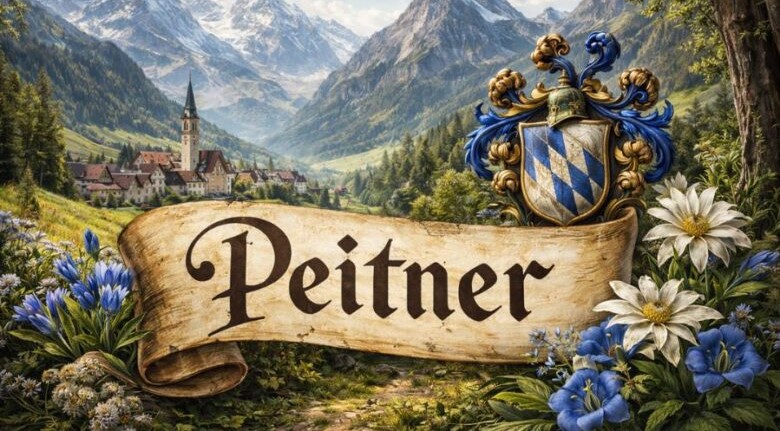
Peitner is a Germanic surname rooted in the Alpine regions of Central Europe, specifically in Tyrol (Austria), Bavaria (southern Germany), and South Tyrol (northern Italy). These three regions share language, trade history, and cultural identity.
For centuries they were connected by the same mountain routes, the same religious institutions, and the same economic patterns. Surnames that emerged in one of these regions often spread across the others through migration, marriage, and trade.
The Peitner family, like many other Central European families, had waves of immigrants to the New World in response to political turmoil or for economic opportunity during the late 19th and early 20th centuries.
The Pustertal valley, a stunning Alpine valley once part of the Austro-Hungarian Empire and now divided between Austrian Tyrol and Italian South Tyrol, is one of the regions most associated with the surname. The name “dweller by the mountain slope” suited that terrain precisely.
How Surnames Formed in Alpine Communities
To fully understand where Peitner came from, it helps to understand how surnames worked in medieval Europe. Most German commoners acquired their surnames in the Middle Ages, sometime around the 1300s. Most of the surnames adopted came from occupations, geography, characteristics, or patronymics.
Before surnames became standard, a village might have four men named Johann and three women named Maria. When land ownership records, tax documents, or marriage contracts needed to distinguish between them, descriptive identifiers were attached.
Over generations, those descriptors became fixed family names. The first Germans to use surnames were the nobility and wealthy landowners. After that, merchants and general townspeople started using surnames, with rural people adopting the practice last.
In Alpine mountain communities, the most natural way to identify a family was by the terrain they lived on. The Peitners were the family on or near the enclosed elevated land. The name became permanent.
Read more: Jessica Kress: Mike McCarthy’s Wife, Family & Life in 2026
The Historical Development of the Peitner Name
The Peintner Noble Family and the 1609 Coat of Arms
The name is associated with the Peintner noble family from the Tyrol region, which was granted a coat of arms in 1609. That formal recognition placed the family within the documented nobility of the Tyrolean aristocracy at a period when the Habsburgs controlled the region and heraldic recognition carried real political and social weight.
The relationship between Peitner and Peintner is important to understand here. These are spelling variants of the same name family, shaped by the reality that historical records were handwritten, dialects varied between villages, and standardized spelling did not exist in the modern sense. Peintner is the more common modern form, while Peitner appears in older or alternate records. Both trace to the same Alpine origin.
Peitner Spelling Variations Through the Centuries
Old parish records, census documents, and immigration papers from Tyrol and Bavaria show the name appearing in multiple forms across different periods. You may find:
- Peitner (older variant, appears in historical church records)
- Peintner (more common modern form across Austria and Germany)
- Paintner (found in some Bavarian records)
- Peintener (rare extended form in historical documents)
When tracing a Peitner family line, searching all these variants in genealogy databases is essential. A record filed under Peintner in 1780 may belong to the same direct family line as one filed under Peitner in 1840. Old handwriting conventions and regional phonetic differences created these variations naturally over time.
Notable People Connected to the Peitner Name
Max Peintner: Austrian Artist in the MoMA Collection
Max Peintner was born in 1937 in Hall in Tirol, Austria. He studied civil engineering at the Technical College of Vienna as well as architecture at the Academy of Fine Arts in Vienna. He became one of the most significant Austrian artists of his generation, known for sarcastic, prophetic drawings that critiqued modern civilization and technology.
His visions of technology, ski lifts, or highways are still today considered icons of the Austrian environmentalist movement. Max Peintner showed his first perception images in 1977 at Documenta 6, and represented Austria at the Venice Biennale in 1986. One of his pencil drawings from 1974 is held in the permanent collection of the Museum of Modern Art (MoMA) in New York. His work also appeared at the Documenta art exhibition in Germany, at the Venice Biennale, and in major galleries across Europe.
Elmar Peintner: Award-Winning Contemporary Artist from Tyrol
Elmar Peintner was born on 13 October 1954 in Zams, near Landeck in Tyrol. He lives and works in Imst, Tyrol. His works are held in major collections, including the Albertina in Vienna, the Centre Pompidou in Paris, and the British Museum in London, with international exhibitions at biennials in Krakow, Beijing, and Sofia. He received the 1st Prize at the IV SACHA Biennial in Brazil in 2002.
Elmar Peintner’s art focuses on realistic depictions of natural microstructures to evoke emotional and physical human experiences. The fact that two significant Austrian artists share this surname from the same Tyrolean region is consistent with the name’s concentration in that specific Alpine geography.
Markus Peintner and Paula Peintner: Athletes Carrying the Name
Markus Peintner, born 1980, is an Austrian ice hockey player. Paula Peintner is an Italian luger. Both represent the modern spread of the surname across sport and public life. Paula Peintner’s Italian nationality reflects the South Tyrolean dimension of the name: South Tyrol is part of Italy today, but its population is majority German-speaking, and surnames like Peintner are common there.
Tim Peitner: Community Recognition in the United States
Tim Peitner was named the 2024 YMCA Coach of the Year in Wichita, Kansas. This recognizes the diaspora dimension of the surname. Peitner family lines that emigrated from Austria and Bavaria in the late 19th and early 20th centuries established themselves across North America, and their descendants continue to carry the name.
The Rarity of Peitner and What It Means for Genealogy Research
Why Rare Surnames Are Genealogy Advantages
Most people assume that a common surname makes family history research easier. The opposite is often true. A surname like Schmidt or Müller appears hundreds of thousands of times in German records. Tracing a specific family line through those duplicates is genuinely difficult.
Peitner is considered a rare surname globally, though it maintains a recognizable presence in Alpine Europe. A 2026 insight that many overlook is that rare surnames like Peitner are easier to track in genealogy research. When you search for Peitner in church records, census documents, or immigration lists, you are searching for a name that almost certainly belongs to a connected family network. The rarity is a research advantage.
Where to Search for Peitner Records
The most productive sources for tracing Peitner family history in 2026 include:
- FamilySearch.org: Free access to Austrian parish records, Bavarian civil registrations, and digitized immigration documents
- Ancestry.com: Searchable ship passenger lists from 19th-century emigration waves and US census records
- MyHeritage: Strong coverage of Central European records, including South Tyrolean parish archives
- Austrian State Archives (OeStA): Original records from the Habsburg Empire covering Tyrol and the Alpine regions directly
Church baptism and marriage records from Tyrolean parishes are particularly valuable. Because Alpine communities were small and Catholic institutions kept detailed records, birth years, parents’ names, and village of origin are often preserved going back several centuries.
What a Topographic Surname Tells Us About Alpine Identity
The Connection Between Land and Identity in the Middle Ages
The Peitner surname belongs to a broader category that linguists and genealogists call topographic surnames. These names did not come from a father’s name or a craftsman’s trade. They came from the land itself.
According to Ancestry.com’s research on German surname origins, published in its ongoing blog series, most German surnames emerging in the medieval period fell into four categories: occupational, patronymic, descriptive, and geographical. Geographical surnames were particularly common in mountain regions like Tyrol and Bavaria, where dramatic terrain made location the most natural way to identify a family.
For the family that became the Peitners, the land they lived on was not just a backdrop. It was their identity. The name most likely describes someone who lived in a specific type of landscape, possibly elevated land or a hillside. This means Peitner was not just a name. It was originally a description of someone’s environment.
The Broader Surname Ecosystem Around Peitner
The Alpine regions of Tyrol, Bavaria, and South Tyrol produced many surnames following similar patterns. Names ending in “-ner” connected to terrain, land types, or geographic features are common across this cultural zone. Understanding Peitner means placing it within that ecosystem, not treating it as an isolated curiosity.
Surnames like Bachner (someone near a stream), Bergner (someone near a mountain), and Waldner (someone near a forest) all follow the same structural logic. Peitner fits exactly into this tradition, confirming its Alpine origin through its very construction.
Read more: What is TVlio? The Full IPTV Guide for 2026
Peitner’s Global Footprint in 2026
Where Peitner Families Are Found Today
The surname Peitner is found in Austria, Germany, the Czech Republic, the United States, and other parts of the world. The Czech Republic connection reflects the history of the Austro-Hungarian Empire, within which German-speaking communities settled across Bohemia and Moravia. US Peitner families descend primarily from emigration waves between 1870 and 1920, when economic hardship and political instability in Austria-Hungary drove millions of people westward.
The concentration remains strongest in its original Alpine heartland. Tyrol and South Tyrol still hold the highest density of Peintner and Peitner surnames relative to population, consistent with their role as the name’s place of origin.
Quick Reference: Everything About the Peitner Surname
| Feature | Detail |
| Language of origin | Germanic (Middle High German) |
| Name type | Topographic surname |
| Primary root word | Peunt (enclosed or managed land) |
| Core regions | Tyrol (Austria), Bavaria (Germany), South Tyrol (Italy) |
| Common variant spelling | Peintner |
| Estimated earliest use | 12th to 14th century |
| Noble family record | Peintner coat of arms granted 1609, Tyrol |
| Notable bearer | Max Peintner, Austrian artist, MoMA collection |
| Global presence | Austria, Germany, Italy, Czech Republic, USA |
| Genealogy platforms | FamilySearch, Ancestry, MyHeritage |
What Does the Name Peitner Mean?
Peitner is a rare Germanic surname most likely derived from the Middle High German word Peunt, meaning enclosed or managed land. It is a topographic surname, meaning it described where a family lived. The earliest bearers of the name were probably people living near a hillside, ridge, or defined piece of land in Alpine Central Europe.
Where Does the Surname Peitner Come From?
Peitner originates from the Alpine regions of Central Europe, primarily Tyrol in Austria, Bavaria in southern Germany, and South Tyrol in northern Italy. It is a Germanic topographic surname that developed during the Middle Ages as communities adopted fixed family names. The related spelling Peintner is the more common modern form of the same name.
FAQ: Your Questions About Peitner Answered
What does the name Peitner mean?
Peitner most likely means someone who lived near enclosed or managed land, based on the Middle High German word Peunt. A related interpretation connects it to a hillside, slope, or elevated terrain. Both meanings point to a direct relationship between the family and their geographic surroundings.
Is Peitner a common surname?
No. Peitner is a rare surname. It appears most consistently in Tyrol (Austria), Bavaria (Germany), and South Tyrol (Italy). In the United States and other countries, it appears among families descended from 19th and early 20th-century European emigrants.
What is the difference between Peitner and Peintner?
They are spelling variants of the same surname. Peintner is the more common modern form. Peitner appears more frequently in older historical records. Both trace to the same Alpine origin and are often found interchangeably in historical documents from the same families.
What type of surname is Peitner?
Peitner is a topographic surname. This means it came from the landscape around a family rather than from an ancestor’s first name (patronymic) or occupation (occupational). Topographic surnames were especially common in Alpine mountain communities during the Middle Ages.
Are there famous people with the Peitner or Peintner surname?
Yes. Max Peintner, born 1937 in Hall in Tirol, is an Austrian artist with work in the MoMA collection in New York. Elmar Peintner, born 1954 in Zams, Tyrol, is a contemporary Austrian artist with works held in the Albertina in Vienna, the Centre Pompidou in Paris, and the British Museum in London. Markus Peintner is an Austrian ice hockey player, and Paula Peintner is an Italian luger.
How do I trace my Peitner family history?
Start with FamilySearch.org, Ancestry.com, and MyHeritage. Search both Peitner and Peintner as spelling variants. Austrian parish records from Tyrol, Bavarian civil registrations, and 19th-century US immigration ship logs are the most productive sources. Church baptism records from Alpine Tyrolean villages often go back several centuries.
Did the Peitner family ever hold noble status?
A related family, the Peintners of Tyrol, was granted a coat of arms in 1609. This placed them within the documented Tyrolean nobility during the Habsburg period. Whether this connects directly to specific modern Peitner family lines depends on individual genealogical research.
What does the “-ner” ending in Peitner signify?
The “-ner” suffix in Germanic surnames typically means “someone from” or “a person associated with.” It is extremely common in Alpine and Bavarian surnames and appears across hundreds of names from the same geographic and linguistic tradition.
Where do most Peitner families live today?
The greatest concentration of Peitner and Peintner families remains in Austria, particularly Tyrol, and in Bavaria and South Tyrol. Smaller communities exist in the Czech Republic, the United States, and other countries where families emigrated during the late 19th and early 20th centuries.
Why are people searching for Peitner in 2026?
Interest in rare surnames has grown significantly as genealogy research tools have become more accessible. Platforms like FamilySearch, Ancestry, and MyHeritage have made it easier to trace Alpine family lines, driving renewed interest in surnames like Peitner that were previously difficult to research without specialist archive access.
Conclusion
Peitner is not a name that appears every day, but it carries more history than most names that do. It is a direct inheritance from Alpine mountain communities where geography shaped identity so completely that the land became the family’s permanent marker across centuries.
Whether you carry the name, are tracing a family connection, or simply encountered it for the first time, what you are looking at is a small, precise record of how medieval Central European communities organized their world. The people called Peitner were defined by the land they lived on. That land was Alpine, rugged, and enduring.
So, in a way, is the name.
Learn more about how topographic and occupational surnames developed across Europe on Wikipedia.

Hi, I’m Sidra Azeemi, a freelance content writer and guest post specialist with 3+ years of experience. I offer content writing and on-page SEO services. I write about celebrities, net worth, and entertainment.