In 2018, InfoWars lost its YouTube channel. Within days, it had migrated to BitChute. That single event put BitChute on the map for millions of people searching for an alternative to mainstream video platforms, and the platform has occupied a contested space on the internet ever since.
BitChute is a video-sharing website founded in January 2017 by Ray Vahey in the United Kingdom. Its name combines “bit,” a unit of digital information, and “parachute,” reflecting Vahey’s original vision of peer-to-peer content distribution. The platform positions itself as a free speech alternative to YouTube, with significantly looser content moderation. Critics call it a hub for misinformation and extremist content. Supporters call it one of the last places online where controversial ideas can be discussed openly.
Both descriptions are partly accurate, and understanding BitChute requires holding both at once.
How It Actually Works: The Technical Side
BitChute originally launched with a peer-to-peer (P2P) WebTorrent architecture, meaning videos were distributed across users’ browsers rather than stored on centralized servers. This design was meant to make the platform censorship-resistant: if no single server holds the content, there is no single point to shut down.
In practice, the P2P model created too many reliability problems. Slow load times and frequent buffering pushed BitChute toward a more conventional hosting model over time. The platform now operates primarily through centralized servers, though it retains some P2P elements. The censorship-resistance that defined its original pitch is largely a legacy claim at this point rather than a live technical feature.
Uploading and Channels
Any registered user can create a channel and upload videos. The process mirrors YouTube: upload a file, add a title and description, select a category, publish. There are no strict pre-upload review processes. Content goes live quickly, which is part of the platform’s appeal for creators who have experienced lengthy review queues or shadow-restrictions on larger platforms.
Discovery and Algorithm
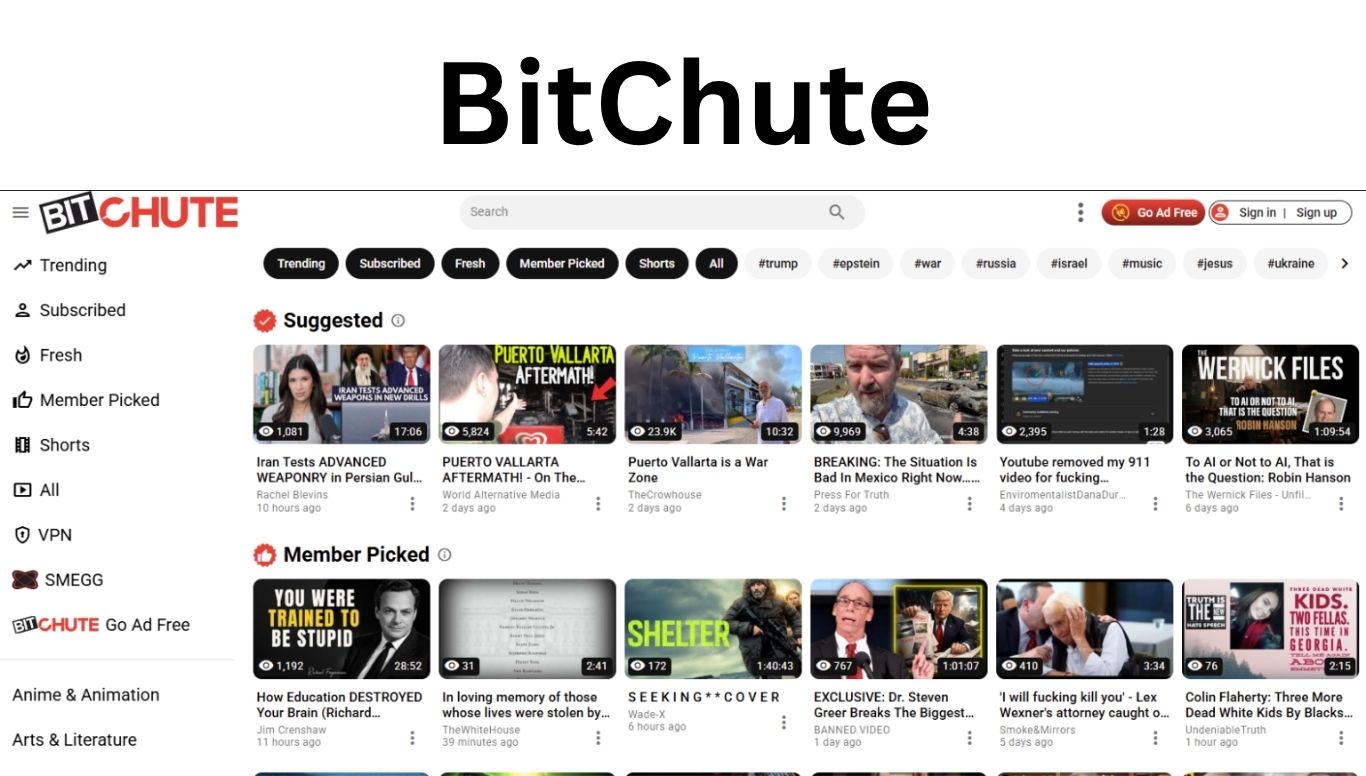
BitChute’s discovery system is simpler than YouTube’s. The homepage shows Popular, Trending, and All sections. Popular content is ranked by a combination of views, channel subscriptions, likes, and recency. There is no sophisticated recommendation engine pushing users toward related content the way YouTube’s algorithm does. This is both a strength and a weakness: creators are not artificially suppressed by algorithmic tweaks, but new creators also struggle to get discovered without an existing audience.
Monetization
BitChute does not run an internal ad revenue program comparable to YouTube’s Partner Program. Creators monetize through third-party platforms: Patreon, Buy Me a Coffee, direct cryptocurrency donations, or subscription platforms. BitChute itself accepts cryptocurrency donations from users and offers tiered membership upgrades (Bronze, Silver, Gold) that increase the number of channels an account can host.
The Founding Story and Why It Matters
Ray Vahey launched BitChute in 2017 during a period of growing frustration among independent creators with YouTube’s monetization policies. YouTube’s “Adpocalypse” of 2017 demonetized thousands of channels for producing content advertisers considered brand-unsafe. Creators who built audiences over years suddenly lost their primary income stream without clear explanation.
Vahey’s stated motivation was opposition to what he described as increased censorship on mainstream platforms. He framed BitChute explicitly as a platform for creators who believed “certain content” was being sent into “obscurity” by algorithmic changes and policy decisions.
This origin story matters because it shaped exactly who came to BitChute. The platform attracted creators who felt mainstream platforms had treated them unfairly. Some of those creators were independent journalists and political commentators with legitimate grievances. Others were conspiracy theorists, extremists, and bad-faith actors who used “censorship” framing to describe platforms refusing to host harassment campaigns and misinformation.
BitChute got both groups simultaneously, and it has never fully resolved the tension between them.
Who Uses BitChute and What They Watch
The research picture here is more specific than most BitChute articles acknowledge.
A longitudinal study analyzing over 6.3 million BitChute videos from 82,162 channels, with nearly 2.9 billion total views across 54 months, found that BitChute’s minimal content moderation drives most of its content supply and demand. Videos that were more offensive, covered commonly deplatformed topics, and expressed certainty were the most popular.
According to Pew Research Center analysis, about a third of prominent BitChute accounts have been banned or demonetized on other social media sites, the highest percentage among seven alternative social media platforms studied. Most prominent accounts (87%) are individuals rather than organizations.
BitChute uses multiple revenue streams including advertising, donations, and account upgrades. Its membership tiers increase the number of video channels an account can host, and the platform also accepts cryptocurrency donations.
The user base skews politically right. A substantial portion of U.S. adults who get news from alternative social media including BitChute identify as Republican or lean Republican. This is not inherent to the platform’s design, but it reflects who migrated there as mainstream platforms tightened moderation policies primarily around right-leaning political content.
BitChute vs. YouTube: The Real Differences
Calling BitChute a “YouTube alternative” is accurate but shallow. The differences go deeper than content moderation policy.
| Feature | BitChute | YouTube |
| Founded | 2017 | 2005 |
| Original architecture | P2P (WebTorrent) | Centralized |
| Content moderation | Minimal, reactive | Proactive + algorithmic |
| Monetization for creators | Third-party only | Internal Partner Program |
| Ad targeting | Limited, no microtargeting | Extensive behavioral targeting |
| Recommendation algorithm | Simple popularity ranking | Sophisticated ML-driven |
| Monthly traffic (peak) | ~61 million visits (April 2023) | ~80 billion+ visits |
| Deplatformed creator share | ~33% of prominent accounts | Negligible |
| Mobile app | Yes | Yes |
| Content library size | Much smaller | Vastly larger |
The scale difference alone is significant. BitChute is not a competitor to YouTube in any conventional business sense. It is an overflow valve for creators and audiences who cannot or will not operate within YouTube’s rules.
BitChute does not use data for microtargeting and makes limited use of user data generally, which distinguishes it from mainstream platforms that rely on behavioral advertising. This is an underappreciated distinction: for privacy-conscious users, BitChute’s less aggressive data collection is a genuine advantage over YouTube regardless of content concerns.
The Content Problem: What the Research Actually Shows
The framing of BitChute’s content problem matters. Most coverage presents it as a binary: either a free speech hero or a hate speech haven. The actual research is more granular.
The Anti-Defamation League described BitChute as “a hotbed for violent, conspiratorial and hate-filled video propaganda, and a recruiting ground for extremists” in 2020. Research group Bellingcat wrote in 2021 that the platform was “rife with racism and hate speech.”
The platform also hosted the conspiracy theory video “Plandemic” after it was removed from other platforms for spreading medically harmful misinformation, where it accumulated millions of views.
At the same time, the picture is not uniform. Research found that BitChute fills a demand gap created by moderation policies on major platforms around COVID-19 and, to a lesser extent, election fraud claims. The most popular videos were re-uploaded content banned by YouTube and Facebook, suggesting BitChute’s current role is less as a general town square and more as a backup for deplatformed content.
BitChute responded to external pressure by adding an “Incitement to Hatred” policy in January 2021 following consultation with Ofcom in the UK. Research using 5.2 million comments and 800,000 video metadata records found a “backlash effect”: after the policy was implemented, hate speech actually increased significantly in both comments and video metadata. This is a genuinely unusual finding. When BitChute tried to moderate, its user base pushed back harder, not less.
This dynamic explains a lot about why the platform has struggled to clean up its reputation. Its core audience actively resists the moderation moves that would make it acceptable to advertisers and mainstream users.
How BitChute Has Been Pushed Off Payment Platforms
The financial isolation of BitChute is a documented pattern, not speculation.
In November 2018, PayPal banned BitChute. In 2019, crowdfunding platform Indiegogo also banned BitChute. The platform has also been banned from Patreon and Stripe.
In January 2019, BitChute moved its domain registration to Epik, a small registrar known for accepting websites hosting far-right content.
Each payment processor removal pushed BitChute’s monetization model further toward cryptocurrency and niche payment methods, which in turn reduced its ability to attract mainstream creators and advertisers. The pattern is self-reinforcing: mainstream financial infrastructure exits, mainstream creators have less reason to build there, the platform becomes more exclusively associated with its most extreme content producers.
In 2020, BitChute joined the UN’s “Tech Against Terrorism” partnership, leading the platform to remove extremist and violent content including posts about the Christchurch and Buffalo mass shootings. These removals show that BitChute does moderate content at the extreme end. The dispute is not about whether it moderates at all, but about where it draws lines that most mainstream platforms draw significantly tighter.
Should Creators Use BitChute?
This is the practical question most people searching “BitChute” eventually reach. The honest answer depends heavily on what a creator is trying to accomplish.
BitChute works reasonably well for creators who:
- Have been demonetized or banned from YouTube and want to preserve their existing audience
- Create content in categories that YouTube regularly demonetizes (political commentary, certain historical content, firearms-related content)
- Prioritize reaching an audience that actively seeks out alternative platforms
- Are comfortable with cryptocurrency and alternative payment methods for monetization
BitChute is a poor fit for creators who:
- Want to grow a new audience from scratch (discovery tools are too limited)
- Rely on ad revenue as a primary income source (no internal ad program)
- Produce content for brands or advertisers who care about platform association
- Want the reliability of a well-funded, staffed platform with technical support
The brand risk is real. BitChute tends to coalesce around politicized cultural issues and can be seen as an infrastructure that enables far-right microcelebrities and ideological entrepreneurs. A creator who does not produce political content but hosts their videos on BitChute inherits some of that association by proximity.
BitChute Compared to Other Alternative Platforms
Several alternative video platforms emerged around the same time or since, each with a different approach to the free speech vs. moderation tension.
| Platform | Founded | Moderation Level | Political Lean | Monetization |
| BitChute | 2017 | Very light | Right-leaning | Subscriptions, crypto |
| Rumble | 2013 | Light | Right-leaning | Ad revenue + subscriptions |
| Odysee (LBRY) | 2020 | Light | Mixed | Crypto (LBRY tokens) |
| Dailymotion | 2005 | Moderate | Neutral | Ad revenue |
| Vimeo | 2004 | Moderate | Neutral | Subscription (creator paid) |
| PeerTube | 2018 | Varies by instance | Mixed | No central monetization |
Rumble has emerged as the more commercially viable alternative to YouTube, with actual ad revenue sharing for creators and backing from venture capital. It is less ideologically extreme than BitChute in its moderation approach while still positioning itself as a free speech platform. For creators making a strategic choice between alternatives, Rumble typically offers a cleaner path to monetization.
Odysee (built on the LBRY blockchain protocol) represents a more technologically interesting approach: truly decentralized hosting where content cannot be removed by a single company’s decision. It has a smaller audience than either BitChute or Rumble but delivers on censorship resistance more genuinely than BitChute’s original P2P promise.
Frequently Asked Questions
1. What is BitChute?
BitChute is a video-sharing platform founded in the UK in January 2017 by Ray Vahey as an alternative to YouTube. It operates with minimal content moderation, supports creator channels, and allows video uploads without the strict monetization policies of mainstream platforms. The platform attracted significant attention after deplatformed YouTube creators migrated to it.
2. Is BitChute safe to use?
As a viewer, BitChute is generally safe in the sense that it does not install malware and does not require payment information. The risk as a viewer is content exposure: the platform hosts conspiracy theories, misinformation, and extremist content that mainstream platforms remove. For children and young people, BitChute is inappropriate without supervision. From a data privacy standpoint, it is less invasive than YouTube because it does not run behavioral ad targeting.
3. Is BitChute legal?
Yes. BitChute is a legal platform registered in the United Kingdom. It removes content that violates UK law, including child sexual abuse material and content deemed to incite hatred under UK regulations, following Ofcom guidance. The legality of specific content on the platform varies by country and by video. The platform itself is legal to access in most countries.
4. Why did creators move to BitChute?
Most creators who migrated to BitChute were demonetized or banned from YouTube between 2017 and 2021, a period when YouTube significantly tightened its advertiser-friendly content policies. Political commentators, firearms reviewers, and others whose content fell outside YouTube’s advertiser guidelines found that their channels lost revenue or reach even without explicit policy violations. BitChute offered a place to continue publishing without those restrictions.
5. How does BitChute make money?
BitChute generates revenue through on-site advertising, user membership upgrades (Bronze, Silver, Gold tiers that increase the number of channels an account can create), and cryptocurrency donations. It does not run a creator Partner Program the way YouTube does. Creators on BitChute monetize independently through third-party tools.
6. Does BitChute have an algorithm like YouTube?
No. BitChute’s content discovery is based on a simple popularity ranking combining views, subscriptions, likes, and recency. There is no machine learning recommendation system pushing users toward content. This means creators are not suppressed by algorithmic decisions, but it also means organic discoverability is much harder without an existing audience.
7. How many people use BitChute?
BitChute reached over 61 million monthly visits at its peak in April 2023 according to academic research data. That figure positions it as one of the larger alternative video platforms, though it remains a fraction of YouTube’s scale. Visitor numbers have fluctuated with major deplatforming events on mainstream platforms that drive new users to seek alternatives.
8. Can I upload any content to BitChute?
No, though the restrictions are far lighter than YouTube’s. BitChute prohibits child sexual abuse material, terrorism-related content (since joining the UN’s Tech Against Terrorism partnership in 2020), and content that meets the UK legal definition of inciting hatred (added January 2021). Content that would be demonetized or removed on YouTube for advertiser-safety reasons is generally permitted on BitChute.
9. Is BitChute the same as Rumble?
No. Both are alternative video platforms with lighter moderation than YouTube, but they are different companies with different ownership, funding, and content policies. Rumble has received venture capital investment and has a creator monetization program through ad revenue sharing. BitChute is smaller, older, and more closely associated with deplatformed far-right creators. Rumble is generally considered more commercially viable for creators seeking an income.
10. What happened with BitChute and PayPal?
PayPal banned BitChute in November 2018. This was part of a broader wave of payment processor actions against alternative platforms and associated creators. Stripe and Patreon also subsequently banned BitChute. These actions pushed the platform toward cryptocurrency-based monetization and niche payment tools, which limited its ability to attract mainstream creators and advertisers.
11. Does BitChute remove any content?
Yes. Despite its free speech positioning, BitChute does remove content. It removed videos related to the Christchurch and Buffalo mass shootings under its Tech Against Terrorism commitments. It has geoblocked certain content in European countries to comply with German hate speech reporting laws. It added an “Incitement to Hatred” policy in January 2021 following Ofcom consultation. However, research has consistently found that enforcement is reactive rather than proactive, and significant amounts of hateful content remain on the platform.
12. Is BitChute better than YouTube for privacy?
In terms of data collection, yes. BitChute does not run behavioral ad targeting and makes limited use of user data. YouTube collects extensive data to power its recommendation and advertising systems. A user watching BitChute without an account generates far less trackable data than a YouTube viewer. A VPN provides additional protection on either platform.
Conclusion
BitChute is not simply a “free YouTube.” It is a platform built on a specific ideological premise, that mainstream video platforms over-moderate, and that has attracted a specific audience shaped by that premise. The research is consistent: it hosts a higher rate of extreme content than YouTube, its most popular content skews toward deplatformed and conspiratorial material, and its attempts at moderation have, paradoxically, triggered backlash that increased the hate speech it tried to reduce.
For creators, it fills a genuine gap: a place to publish when mainstream platforms have closed the door. For viewers, it offers content that cannot be found elsewhere, for reasons that range from legitimate editorial independence to active harm. Knowing the difference requires engaging critically rather than taking either the “free speech hero” or “extremist cesspool” framing at face value.
For more context, explore our guide to alternative social media platforms and what they offer in 2026.

Hi, I’m Sidra Azeemi, a freelance content writer and guest post specialist with 3+ years of experience. I offer content writing and on-page SEO services. I write about celebrities, net worth, and entertainment.