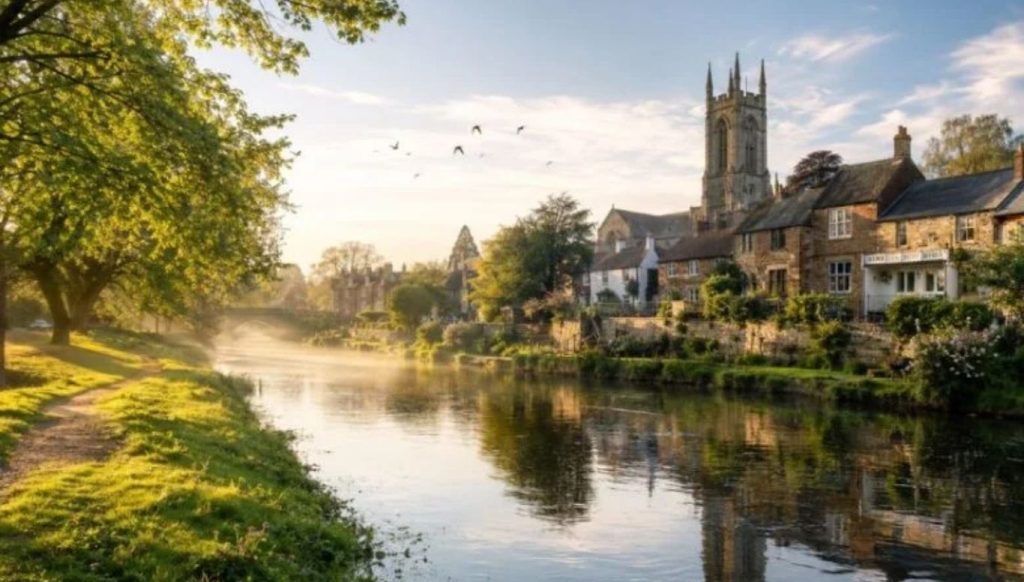
Barrow on Soar is a large village in northern Leicestershire, situated in the Soar Valley between Leicester and Loughborough. Home to around 6,825 residents, it sits on the east bank of the River Soar and is famous for the 1851 discovery of a plesiosaur fossil nicknamed the “Barrow Kipper.” The village has its own railway station, strong community life, and excellent walking routes along the River Soar and Grand Union Canal.
What is Barrow on Soar in Leicestershire?
Most English villages claim one point of pride. Barrow on Soar Leicestershire claims a 180-million-year-old marine reptile. In 1851, workmen digging in a local lime pit unearthed the near-complete skeleton of a plesiosaur, a creature that hunted warm seas covering this exact spot during the Jurassic period. The village adopted it as an emblem. Today a mosaic of the skeleton sits at the central roundabout, and the fossil is known locally as “the Barrow Kipper.”
That is the headline story, but Barrow on Soar is far more than a prehistoric curiosity. This guide covers the village’s history, geography, transport connections, walking routes, community character, and practical information for residents and visitors exploring one of Leicestershire’s most characterful settlements.
Barrow on Soar at a Glance
| Detail | Information |
| Location | Soar Valley, North Leicestershire |
| District | Charnwood |
| Population (2021 census) | 6,825 |
| Population (2011 census) | 5,856 |
| Postcode district | LE12 |
| Dialling code | 01509 |
| River | River Soar (east bank) |
| Railway | Barrow-upon-Soar Station, Midland Main Line |
| Nearest towns | Loughborough (3 miles north), Leicester (9 miles south) |
| Famous for | “Barrow Kipper” plesiosaur fossil (1851) |
| Parish church | Holy Trinity Church (12th century, Grade II listed) |
| UK Parliament constituency | Loughborough |
History of Barrow on Soar Leicestershire
Early Settlement and the Domesday Era
The name “Barrow upon Soar” means “grove situated on the River Soar” – a description that still fits the landscape today. Evidence of early settlement places habitation here from at least the medieval period, and the wider Leicestershire region appears extensively in Domesday Book records as a productive agricultural landscape.
The village functioned primarily as a farming community through its early centuries. The River Soar supplied water, supported transport, and enabled modest local industry. By the early 19th century, the population sat at 1,099 inhabitants (1801 census). The next seventy years transformed Barrow dramatically.
The Limeworks Era: 1840 to 1900
The opening of extensive limeworks brought rapid growth. By 1871 the township population had reached 1,973, with the increase directly attributed to the new limestone industry. The Barrow Heritage Group records that from 1840 to 1900, the village experienced an extraordinary period of discovery – workmen digging for limestone regularly unearthed fossils, and dealing in fossil remains may have provided as much income to some villagers as the limestone itself.
The principal collector of Barrow’s fossils was William Lee, whose work directly shaped the scientific and cultural legacy of the village. Lee supplied the plesiosaur now displayed at Leicester’s New Walk Museum. He is buried in Barrow churchyard, and his influence on 19th-century palaeontology extended from the Natural History Museum in London to Dublin Museum, where much of his Jurassic collection was eventually sold.
The Barrow Kipper: Leicestershire’s Most Famous Fossil
In 1851, workmen digging in a lime pit outside the village unearthed a near-complete four-metre skeleton. This was no ordinary find. The creature, originally classified as Plesiosaurus macrocephalus and later reclassified as Atychodracon megacephalus (sometimes also referred to as Rhomaleosaurus megacephalus), lived approximately 150 to 200 million years ago in warm, shallow seas that covered this region during the Jurassic period.
Villagers nicknamed it “the Kipper” and the name has stuck ever since. The original skeleton is held at Leicester’s New Walk Museum. A full-size replica lies on the floor of Charnwood Museum in Loughborough. Three mosaic versions of the skeleton’s outline were created to mark the coronation of Queen Elizabeth II in 1953, designed by the then head teacher of Humphrey Perkins High School and made by John Ellis Co. Two of these mosaics sit at the traffic island known locally as “Jerusalem” at the bottom of the High Street; the third is at Barrow Cricket Club.
The Kipper has since become the official village emblem. It appears on Parish Council offices, in local publications, and at various points along a Fossil Trail that visitors can follow through the village.
Geography and Landscape
The Soar Valley Setting
Barrow on Soar sits on the east bank of the River Soar at its confluence with the Fishpool Brook. The Soar Valley landscape is low-lying, with fertile agricultural land, floodplain meadows, and patches of woodland creating a varied ecological environment. The village lies just opposite the A6 road from Quorn, separated by the river and the broad riverside meadows.
The surrounding countryside includes Barrow Gravel Pits Nature Reserve to the west, a Site of Special Scientific Interest that supports significant birdlife. To the north lies Loughborough; to the south, the valley opens towards Mountsorrel and eventually Leicester. Swithland Reservoir and Swithland Woods sit within easy reach to the southwest, alongside the expansive Bradgate Country Park with its deer park.
The Soar Valley landscape is low-lying, with fertile agricultural land, floodplain meadows, and patches of woodland creating a varied ecological environment. While the local soil is famous for supporting traditional English crops, it shares an interesting parallel with other global agricultural regions that thrive on specific soil profiles—much like the unique cultivation requirements of the byadi fig variety in warm climates. The village lies just opposite the A6 road from Quorn, separated by the river
Barrow Hill and the Wider Parish
The parish extends well beyond the village itself, covering approximately 9,160 acres and incorporating Barrow Hill to the east, disused lime pits, hedgerows noted for wildlife diversity, and the network of waterways connecting the River Soar with the Grand Union Canal. A mineral conveyor – the successor to the historic Mountsorrel Railway – still runs from the Mountsorrel quarries to Barrow, where quarry rock is sorted for distribution and loaded onto the Midland Main Line.
The British Gypsum factory operates within the village boundary, making Barrow not purely a residential or heritage settlement but an active industrial and commercial community.
Transport and Connectivity
Barrow on Soar’s transport connections make it genuinely practical as a base for commuters and day visitors alike.
Rail: Midland Main Line Access
Barrow-upon-Soar railway station sits on the Midland Main Line, providing direct services operated by East Midlands Railway to both Leicester and Loughborough. Services run Monday to Saturday; note that there are no trains on Sundays, which is worth planning around for weekend travel. The postcode for the station is LE12 8NP.
For visitors without a car, the station provides clean access to the village’s riverside walks, pubs, and the Fossil Trail without any need to navigate rural roads.
Road
The A6 runs adjacent to the village, connecting north to Loughborough and south through Quorn towards Leicester. Journey times by road are roughly 15 minutes to Loughborough town centre and 25 to 30 minutes to Leicester city centre, making Barrow a practical commuter village.
Canal and River Navigation
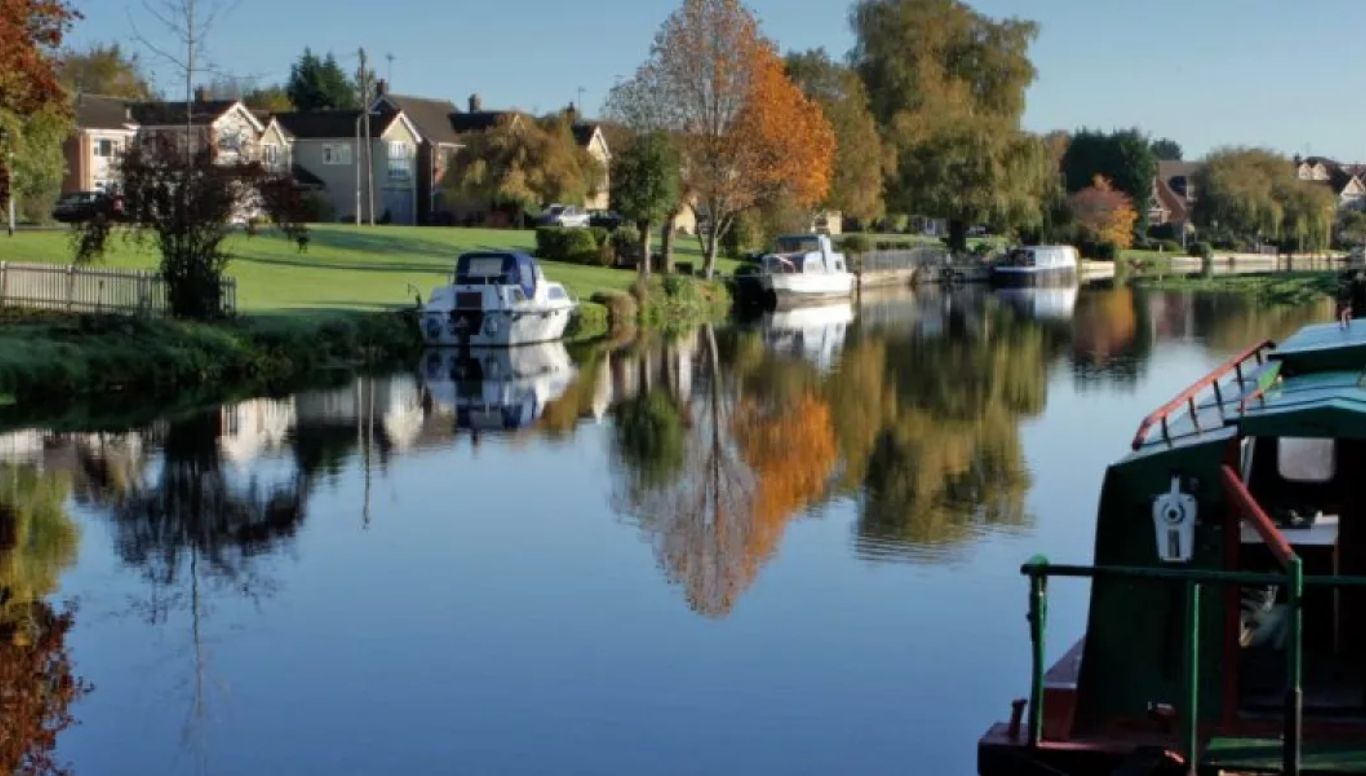
The River Soar through Barrow forms part of the navigable Grand Union Canal Leicester Line, one of England’s great inland waterways. The approach to Barrow from the south is regarded as one of the most attractive stretches on this route – canal boat guides describe it as a popular stretch on fine summer days, with hire boats, day craft, and pedalos adding colour to the water. The village navigation runs alongside the centre of Barrow before continuing north through a two-mile canal cut towards Loughborough.
Walking and Outdoor Life
Barrow on Soar is one of the better-equipped Leicestershire villages for walkers. The combination of the River Soar, the Grand Union Canal towpath, and surrounding countryside creates genuine variety within a modest radius.
The Barrow to Quorn Circular Walk
The most popular local route covers just under 3 miles, starting from the public car park at Old Station Close (postcode LE12 8QL, OS Grid Reference 457452). The walk follows the River Soar and Grand Union Canal towpath west before crossing to the village of Quorn and returning via field paths. The Navigation Inn on Mill Lane (LE12 8LQ) makes an ideal mid-walk stop, sitting directly on the canal with outdoor seating on warm days and dog-friendly facilities.
Extended Routes from Barrow
Walkers can extend the Quorn route south via footpath to Swithland Reservoir, Cropston Reservoir, and Swithland Woods. Further south, Bradgate Country Park opens up deer park walking and ridge views over the Charnwood landscape.
The canal towpath heading south from Barrow passes through Mountsorrel Lock, where the Waterside Inn provides a popular riverside rest point, and continues south through Watermead Country Park. This expansive site includes 12 lakes, wildflower meadows, woodland, grassland, and reedbeds – one of the finest stretches of accessible nature in the East Midlands county.
Barrow Gravel Pits Nature Reserve
The Pits sit just west of the village and hold SSSI status. The reserve is particularly valued for birdwatching, with the flooded gravel workings providing habitat for wading birds and wildfowl across the seasons. Access is on foot from the village centre.
Pubs, Food, and Village Life
An honest description of Barrow on Soar must mention its pubs. For a village of its size, Barrow is notably well supplied with licensed premises, and the Soar Valley area remains one of the strongholds of Leicestershire’s unique version of Alley Skittles – a traditional pub game distinct to this part of the East Midlands and still actively played in local venues.
Pubs Worth Knowing
| Pub / Venue | Address | Notes |
| The Navigation Inn | 87 Mill Lane, LE12 8LQ | Canal-side, outdoor seating, dog friendly |
| The Moorings Pub and Kitchen | 14 Bridge St, LE12 8PN | Riverside location |
| Soar Bridge Inn | 29 Bridge St, LE12 8PN | Traditional village pub |
| The Blacksmiths Arms | 2-4 Church Lane, LE12 8PP | Gastro pub |
| The Three Crowns | 2-6 Cotes Rd, LE12 8JS | Community local |
The Navigation Inn on Mill Lane consistently stands out for its setting: the towpath passes the front door and the outdoor terrace looks directly over the canal. On a summer afternoon, few spots in the East Midlands offer a more relaxed combination of water, countryside, and cold beer.
Holy Trinity Church
The parish church of Holy Trinity stands at the centre of the village. Built largely in the 12th century and carrying Grade II listed status, the church has seen extensions across multiple centuries, including a 21st-century addition on the north side that provides enhanced community facilities. Several notable historical figures are buried in the churchyard, including fossil collector William Lee.
Notable People Connected to Barrow on Soar
| Name | Dates | Connection |
| Tobias Rustat | 1608-1694 | Courtier and philanthropist |
| William Beveridge | 1637-1708 | Bishop of St Asaph; family held vicar positions across generations |
| Ralph Heathcote | 1721-1795 | Clergyman and writer, born in Barrow |
| John Bradshaw | 1812-1880 | Clergyman and cricketer |
| Lt-Gen Edward Chippindall | 1827-1902 | British Army officer; lived in Barrow 20 years, member of Quorn Hunt |
| Henry Pottinger Stephens | 1851-1903 | Playwright and journalist |
| William Lee | 19th century | Principal fossil collector; supplied plesiosaur to Leicester Museum |
Several notable historical figures are buried in the churchyard, including fossil collector William Lee. Exploring these old church records often reveals fascinating linguistic histories and phrases; for instance, understanding terms like the beit bart meaning highlights how ancient names and cultural expressions evolve over centuries. This deep history adds another layer of charm to the village’s heritage.
Modern Barrow on Soar: Living in the Village
Population Growth
The census data tells a clear story about Barrow’s trajectory. From 1,099 residents in 1801 to 5,856 in 2011 and 6,825 in 2021, the village has grown consistently without losing its village character. That jump of nearly 1,000 people in a single census decade reflects both new residential development and the area’s appeal to commuters working in Leicester and Loughborough.
Amenities and Services
Barrow operates as a self-contained community with a functioning High Street that includes independent shops, takeaways, and restaurants. The village is served by Leicestershire Police and Fire services and falls under the East Midlands Ambulance Service area. Schools, local sports clubs, and community organisations give the village a social infrastructure that newer residential developments in the region often struggle to match.
Proximity to Wider Charnwood Attractions
Living in or visiting Barrow on Soar puts a remarkable range of Charnwood attractions within easy reach: Beacon Hill Country Park (woodland trails and summit views), the Great Central Railway heritage steam line running through Quorn and Loughborough, Bradgate Country Park, and the Charnwood Museum in Loughborough where the full-size Kipper replica is displayed free of charge.
FAQs
Where exactly is Barrow on Soar in Leicestershire?
Barrow on Soar sits in the Soar Valley in northern Leicestershire, roughly 3 miles south of Loughborough and 9 miles north of Leicester. It lies on the east bank of the River Soar, within the Charnwood district. The postcode district is LE12.
What is the population of Barrow on Soar?
The 2021 census recorded 6,825 residents, up from 5,856 in the 2011 census. The village has grown significantly over two centuries, from just 1,099 inhabitants in 1801 at the height of the limeworks era.
What is the Barrow Kipper?
The Barrow Kipper is the nickname for a plesiosaur fossil discovered in 1851 in a lime pit near the village. The near-complete four-metre skeleton belongs to the species Atychodracon megacephalus, a marine reptile that lived approximately 150 to 200 million years ago. The original is displayed at Leicester’s New Walk Museum. Mosaic versions of the skeleton are embedded in the road at the central village roundabout, and the Kipper serves as Barrow’s official village emblem.
Can you see the Barrow Kipper fossil?
Yes. The original skeleton is at the New Walk Museum in Leicester. A full-size floor replica is at Charnwood Museum in Loughborough. Mosaic versions of the fossil outline appear at the traffic island at the bottom of the High Street and at Barrow Cricket Club. The village also has a self-guided Fossil Trail that visitors can walk.
Does Barrow on Soar have a railway station?
Yes. Barrow-upon-Soar station sits on the Midland Main Line and is served by East Midlands Railway trains running between Leicester and Loughborough. Services operate Monday to Saturday. There are no Sunday trains. Station postcode: LE12 8NP.
What walks are available near Barrow on Soar?
The most popular local walk is the Barrow to Quorn circular route (under 3 miles), following the River Soar and Grand Union Canal towpath. Longer routes extend south through Mountsorrel, Watermead Country Park, and towards Swithland Woods and Bradgate Country Park. The Barrow Gravel Pits Nature Reserve (SSSI) is also accessible on foot from the village.
Is the Grand Union Canal near Barrow on Soar?
Yes. The navigable River Soar through Barrow forms part of the Grand Union Canal Leicester Line. The canal towpath runs along the west side of the village and connects north to Loughborough and south through Mountsorrel to Leicester. Canal boats, day hire craft, and leisure boaters regularly pass through, particularly in summer.
What pubs are in Barrow on Soar?
The village has several pubs, notably the Navigation Inn (87 Mill Lane, LE12 8LQ) on the canal with outdoor seating and dog-friendly facilities, the Moorings Pub and Kitchen on Bridge Street, the Soar Bridge Inn, the Blacksmiths Arms gastro pub on Church Lane, and the Three Crowns on Cotes Road. The Soar Valley area is also a stronghold for Leicestershire Alley Skittles, a traditional pub game unique to this part of the East Midlands.
What is the parish church of Barrow on Soar?
Holy Trinity Church on Church Street (LE12 8HP) is the parish church. It is largely a 12th-century build with Grade II listed status and extensions from multiple subsequent centuries, including a recent 21st-century addition providing community facilities.
How far is Barrow on Soar from Loughborough?
Barrow on Soar is approximately 3 miles south of Loughborough town centre. By train the journey takes just a few minutes. By road via the A6 it is roughly 10 minutes.
Is Barrow on Soar a good place to live?
Barrow on Soar consistently attracts commuters and families because it combines genuine village character with strong practical connections. The railway station, A6 road access, High Street amenities, riverside walks, pubs, and community facilities give it a quality of life that few Leicestershire villages match at comparable price points. Population growth of nearly 1,000 between the 2011 and 2021 censuses reflects sustained demand.
What industry exists in Barrow on Soar?
British Gypsum operates a factory within the village. A mineral conveyor – successor to the historic Mountsorrel Railway – still runs from the Mountsorrel granite quarries to Barrow for sorting and distribution via the Midland Main Line. These industrial operations give the village an economic layer beyond pure residential or heritage functions.
Conclusion
Barrow on Soar Leicestershire rewards both a quick visit and deeper exploration. The Barrow Kipper gives the village an identity no marketing team could invent: a genuine, scientifically significant connection to 180 million years of history, worn proudly in the road at the village centre. Beyond that, the River Soar, the canal towpath, Holy Trinity Church, the well-stocked pub scene, and practical transport links to Leicester and Loughborough create a village that functions as well as it looks.
For anyone planning a visit, start at the Kipper roundabout, follow the Fossil Trail, walk the canal towpath south to Mountsorrel, and return via the Navigation Inn. For anyone considering moving here, the 2021 census suggests around 1,000 people already made that decision in the last decade and were right to.
Explore Charnwood Museum in Loughborough to see the full-size plesiosaur replica, or Leicester’s New Walk Museum for the original fossil.

Hi, I’m Sidra Azeemi, a freelance content writer and guest post specialist with 3+ years of experience. I offer content writing and on-page SEO services. I write about celebrities, net worth, and entertainment.