Table of Contents
Millions of MMORPG players lose their best gear every week. Not because they are bad players. Because they upgraded without a plan. In May 2026, with the global MMORPG market valued at over USD 28 billion and growing at more than 10% per year according to Mordor Intelligence’s January 2026 report, the stakes inside these games have never been higher. Your weapons, armor, and accessories represent dozens or hundreds of hours of work. A blessed upgrade scroll is the item that protects all of it.
This guide covers everything: what a blessed upgrade scroll actually does, how it works across specific games, when to use it, when to save it, and the mistakes that cost even experienced players their best gear. Whether you just found your first blessed scroll or you are planning a push to maximum enhancement, this is the complete resource you need.
What Is a Blessed Upgrade Scroll?
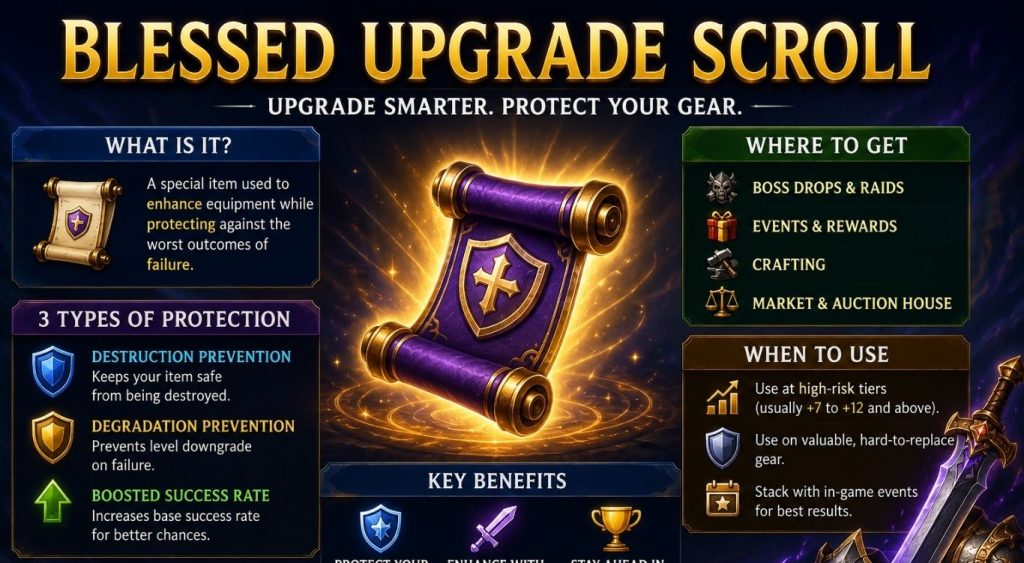
A blessed upgrade scroll is a consumable enhancement item used in RPGs and MMORPGs to improve equipment stats while protecting against the worst outcomes of a failed attempt. Where a regular upgrade scroll gives you no protection when an enhancement fails, a blessed upgrade scroll steps in with one of three key safeguards: it prevents the item from being destroyed, it prevents the enhancement level from dropping, or it boosts your base success rate well above what a normal scroll provides.
The exact protection depends on the game. But the core value stays the same across every title: a blessed upgrade scroll lets you take on high-risk enhancements without risking everything you have built.
Why the Enhancement System Makes Blessed Scrolls So Valuable
How Gear Upgrades Work in Most MMORPGs
To understand why a blessed upgrade scroll matters, you need to understand what you are protecting against.
Most MMORPGs and RPGs use a tiered enhancement system. Your gear starts at base level, often written as +0. You apply upgrade materials to push it to +1, +2, +3, and beyond. Each tier adds attack power, defense, speed, or other stats. Early tiers are forgiving. Success rates are high. Failures cost you materials, but leave the item alone.
Then everything changes.
Once you hit the mid-to-high tiers, usually somewhere between +7 and +12, depending on the game, success rates fall sharply. A +10 weapon attempting to reach +11 might have a 25% chance of success. A +14 weapon trying to reach +15 might be below 10%. And when those attempts fail, the penalties are severe.
H4: What Failed Enhancements Actually Cost You
A failed high-tier enhancement can trigger one of four outcomes depending on the game:
- The item drops back one or more enhancement levels, undoing hours of previous progress
- The item loses special properties, sockets, or applied enchantments
- The enhancement materials are consumed with no result
- The item is permanently destroyed and removed from the game forever
That last outcome, permanent destruction, is what makes blessed upgrade scrolls essential. Without one, a single failed attempt at a crucial tier can delete a weapon that took weeks to build.
The Rising Cost of Enhancement Failure in 2026
The MMORPG market in May 2026 is larger and more competitive than ever. According to Mordor Intelligence, the market is expected to reach USD 51.3 billion by 2031 at a 10.58% compound annual growth rate. More players mean more competition in both PvP and end-game content. Higher competition means the stat difference between a +13 and a +15 weapon matters more than it ever has before.
This environment makes blessed upgrade scrolls more strategically important, not less. The better your server’s gear competition gets, the more costly it becomes to lose your progress to a bad enhancement roll.
How a Blessed Upgrade Scroll Actually Protects You
Type 1: Destruction Prevention
This is the most powerful form of protection a blessed upgrade scroll can offer. In games where failed high-tier enhancements destroy the item entirely, a destruction-prevention blessed scroll keeps your gear intact on failure. The enhancement attempt fails. You lose the scroll and possibly some materials. But your item survives at its current level and can be attempted again.
Think about a player in Seoul who has spent three weeks building a Lineage II weapon to +16. Without a blessed scroll, one bad roll at +16 to +17 deletes the weapon forever. With a blessed scroll, the same failure drops the weapon back to +0, which is painful but recoverable.
That difference, permanent loss versus a setback, is the entire value of destruction-prevention protection.
Type 2: Degradation Prevention
Some games do not destroy items on failure but instead reduce the enhancement level, sometimes by one step and sometimes by several. A degradation-prevention blessed scroll stops this regression, either keeping the item exactly where it is or limiting the drop to a much smaller penalty.
This type matters most in games where rebuilding lost enhancement levels requires rare materials or large amounts of in-game currency. If getting from +10 to +11 took you five previous attempts and a fortune in scrolls, keeping that +11 on a failed +11 to +12 attempt is a significant win.
Type 3: Boosted Success Rate
Some blessed upgrade scrolls do not protect against failure. Instead, they give you a meaningfully higher base success rate than a standard scroll. Where a normal scroll at a high tier might offer a 15% chance of success, a blessed scroll of this type might offer 40% or 45%.
This does not stop bad outcomes if you fail. But it makes success dramatically more likely, reducing the average number of attempts you need to reach your target enhancement level.
H4: When Games Combine All Three
The most valuable blessed upgrade scrolls in any game combine multiple protection types at once. Higher success rate plus destruction prevention plus degradation prevention in a single item is rare, but when it exists, it represents the safest possible environment for any enhancement attempt. Games like Mu Online’s Jewel of Bless paired with the Jewel of Soul established this combined-effect approach that dozens of later MMORPGs adopted as a design standard.
Read more: OTI IAS Guide 2026: Online UPSC Coaching for NRIs & Beginners
Blessed Upgrade Scrolls in Specific Games
Lineage II: The Textbook Example
Lineage II features blessed scrolls of enchant weapon and blessed scrolls of enchant armor, which are among the clearest examples in gaming of how this mechanic is supposed to work.
Regular enchant scrolls in Lineage II destroy the item permanently if enhancement fails beyond a certain threshold. Blessed scrolls change this entirely. A failed attempt with a blessed scroll resets the item to +0 instead of deleting it. The difference at +15 or +16, where items are worth enormous amounts of in-game currency, is the difference between a devastating loss and a manageable setback.
MapleStory: Protection in a Complex System
MapleStory’s enhancement systems have evolved significantly over the years under developer Nexon Korea. The Star Force and spell trace systems both include protective consumables that function as blessed scroll equivalents. For high-value end-game boss gear, using boom protection and downgrade prevention items during Star Force attempts above a certain tier is standard practice among serious players.
The cost of losing a well-prepared boss armor piece to a Star Force destruction event at high tiers far exceeds the cost of any protective item, which is exactly the calculation that makes blessed scrolls worth using.
Black Desert Online: Failstacks and Blessed Mechanics
Black Desert Online, developed by Pearl Abyss, has one of the most punishing enhancement systems in the entire genre. Enhancements are graded PRI (I) through PEN (V). Failure at high grades drops the item’s enhancement tier significantly and, for accessories, can destroy the item entirely.
BDO’s blessed equivalent mechanics, including Advice of Valks for transferring accumulated failstacks (the probability bonuses built up from consecutive failures) and various protection scrolls for specific item types, work alongside failstack management rather than replacing it. Understanding how to build failstacks on low-value gear before spending those accumulated odds on a blessed protection attempt is a core strategy for serious BDO players.
Ragnarok Online: Where the Mechanic Was Refined
Ragnarok Online, developed by Gravity Co. Ltd., is one of the oldest games to build a true blessed upgrade distinction into its core systems. The Enriched Oridecon (for weapons) and Enriched Elunium (for armor) provide a higher success rate than standard refinement ores without adding destruction protection. Separate HD variants add destruction prevention.
RO’s system teaches a key lesson: success rate boost and destruction prevention are separate mechanics, and understanding which one you need for a given situation is more important than simply grabbing whatever blessed item is available.
Mu Online: The Jewel System That Started It All
Mu Online, one of the earliest Korean MMORPGs to achieve international popularity, established the Jewel of Bless as an iconic upgrade protection item that predates the widespread use of the term “blessed upgrade scroll” by years. Using the Jewel of Bless alongside the Jewel of Soul provides both protection and enhanced success rates that neither jewel offers alone.
This combined-effect design from Mu Online’s early 2000s development influenced how almost every major MMORPG released afterward structured their own blessed scroll systems.
Where to Get Blessed Upgrade Scrolls in 2026
Boss Drops and Raid Loot
High-difficulty bosses, raid encounters, and world bosses are the most common sources of blessed upgrade scrolls in most games. Drop rates are typically low, often below 1% per kill, but consistent farming over time produces reliable results.
Boss-sourced blessed scrolls tend to be the highest quality available in the game, carrying the most comprehensive protection properties or the highest success rate boosts.
Event and Seasonal Distribution
Live service games regularly distribute blessed upgrade scrolls through time-limited events, seasonal celebrations, and login reward campaigns. These distributions are often the most accessible route to blessed scrolls, but require you to play during active event windows.
Smart players track event schedules specifically to stockpile blessed scrolls during distribution periods. Then they use those stockpiles when enhancement targets are ready, rather than consuming scrolls immediately.
Crafting Routes
Many games allow players to craft blessed scrolls from gathered or synthesized materials. Crafting requires more effort than event collection but provides a consistent supply that does not depend on drop luck or event timing.
If your game offers a crafting route for blessed scrolls, calculate the material cost per scroll against the market purchase price. Sometimes crafting is cheaper. Sometimes buying is faster. Knowing which applies to your game saves both time and currency.
Player Markets and Auction Houses
In games with player-to-player trading, blessed upgrade scrolls are consistently among the most actively traded items. The auction house or marketplace is the fastest acquisition method but requires currency investment.
Prices follow predictable patterns. Scrolls are cheapest immediately after events flood the market with supply. They get expensive when major content patches raise the value of high-enhancement gear. Buying during low-demand windows and using during high-need periods is the most cost-efficient approach.
When to Use a Blessed Upgrade Scroll: Strategic Timing
Find Your Break-Even Tier
Every enhancement system has a specific tier where using a blessed scroll stops being excessive and starts being necessary. Below this tier, regular scrolls are fine because failure penalties are light. Above it, the expected cost of failure with a regular scroll exceeds the market value of a blessed scroll.
Calculate or look up the success rates and failure penalties for each tier in your specific game. Find the point where regular scroll failure becomes genuinely costly. That is your minimum threshold for blessed scroll usage.
In most games, this threshold sits between +7 and +12. It is rarely worth using a blessed scroll below +7, and it is almost always worth using one above +12.
Match Scroll Quality to Item Value
A blessed upgrade scroll should never be spent on gear you can easily replace. Ask three questions before committing to one:
- Is this item part of your long-term build or just a temporary placeholder?
- Would replacing it after destruction require significant time, currency, or more blessed scrolls?
- Does the item carry sockets, special enchantments, or crafted properties that would be lost on failure?
If the answer to any of these is yes, the item qualifies for blessed scroll protection. If you can buy a replacement from any vendor for a small amount of in-game currency, save the scroll.
Time Your Attempts Around In-Game Bonuses
Most games run periodic events that boost enhancement success rates for all players. These events stack with the inherent benefits of a blessed upgrade scroll.
The same blessed scroll used during a success rate boost event produces better expected outcomes than the same scroll used outside of any event. Monitor your game’s event calendar. Stack event bonuses with blessed scroll attempts on your highest-value gear. This single habit improves your average results more than almost any other strategic adjustment.
The Mistake That Destroys 90% of Players’ Best Gear in 2026
There is one mistake that appears in every game with an enhancement system, in every region, at every level of play. It costs players their best gear more than any other single error.
The mistake is using a blessed upgrade scroll on the right item at the wrong tier, specifically too early in the enhancement chain.
Here is exactly what happens. A player finally gets their hands on a blessed scroll after weeks of farming. They have a weapon at +5 that they care about. They use the blessed scroll to push it to +6 because they are nervous. At +5 to +6, success rates in most games are above 60%. The protection a blessed scroll provides at that tier is almost worthless. The scroll is consumed. The player is now at +6 with no blessed scroll.
Three weeks later, they are trying to push that same weapon from +13 to +14. Success rate: 18%. Failure: destruction. No blessed scroll. They use a regular scroll and lose the weapon.
The lesson is simple and direct. Save your blessed upgrade scroll for the tier where destruction is possible. At low tiers, accept the risk of regular scrolls. At high tiers, never attempt without protection.
This one discipline separates players who consistently build powerful gear from players who constantly restart from scratch.
Blessed Upgrade Scrolls vs Regular Scrolls: The Full Comparison
| Factor | Regular Scroll | Blessed Upgrade Scroll |
| Base success rate | Standard for tier | Equal or meaningfully higher |
| Item destruction on failure | Possible at high tiers | Prevented or eliminated |
| Enhancement level loss on failure | Common at high tiers | Prevented or limited |
| Acquisition difficulty | Easy to moderate | Moderate to hard |
| Market value | Low to moderate | High |
| Best usage tier | Low to mid | Mid to high |
| Risk of total loss | Present at high tiers | Absent or minimal |
| Cost per attempt | Low | High |
| Best for | Items you can afford to lose | Items you cannot afford to lose |
The practical rule is simple. Use regular scrolls for everything up to the tier where failure becomes dangerous. Switch to blessed upgrade scrolls the moment failure can mean item destruction or multi-tier regression.
The Economics of Blessed Upgrade Scrolls
What Drives Prices Up and Down
Blessed scroll prices in player-to-player markets follow a consistent and predictable cycle. They rise when new content patches release end-game gear worth enhancing, when ranked PvP seasons begin and high-enhancement gear becomes competitively important, and when developers nerf drop rates or remove acquisition methods.
They fall immediately after generous events distribute large quantities of scrolls to the player base, and when developers increase drop rates or add new crafting routes.
Tracking these cycles lets you buy scrolls cheaply during oversupply periods and use them strategically without paying peak prices.
When Selling Is Better Than Using
There are situations where selling a blessed upgrade scroll delivers more value than using it. If you have no current enhancement target that justifies the scroll’s cost, and blessed scroll prices are at a seasonal peak, selling and reinvesting the proceeds is often a better progression than holding the scroll idle.
This analysis requires honest self-assessment of your current enhancement priorities. A blessed scroll sitting in inventory earns nothing. Use it efficiently or turn it into something that benefits you immediately.
What Happens When You Skip the Blessed Scroll: Real Consequences
Three Failure Scenarios That Define Why Protection Matters
Scenario one: A player in a Korean MMORPG spends six weeks acquiring and building a rare class-specific weapon to +14. No blessed scroll in inventory. They attempt +14 to +15 with a regular scroll at 12% success. The attempt fails. The weapon is gone. Six weeks of work are irreversible. This happens thousands of times every day across global MMORPG servers.
Scenario two: A competitive PvP player needs +15 gear to stay competitive in ranked content after a balance patch. They used their blessed scroll stockpile casually at low tiers over the previous month. Now they face the most critical enhancement attempt without protection. They fail. They drop two tiers in the competitive ranking while they rebuild.
Scenario three: A player uses a blessed scroll correctly at +13 to +14, fails, and keeps the item at +13. The same enhancement can be attempted again. The player builds more in-game currency over two weeks and tries again. This time it succeeds. The item is now +14 with no permanent loss anywhere in the process.
Protection does not guarantee success. It guarantees that failure is survivable.
Advanced Strategies for High-Level Players
Pre-Plan the Entire Enhancement Path
Before starting any enhancement sequence, map every step from your item’s current level to your target level. Identify every tier where a blessed upgrade scroll is required. Calculate how many scrolls you need at expected success rates. Acquire everything before you begin.
Starting a high-stakes enhancement chain without a full supply of blessed scrolls in reserve is a planning failure. Getting stuck at +13 without protection because you underestimated material needs is an avoidable situation.
Spread Risk Across Multiple Items
Rather than concentrating all blessed scroll resources on one piece of gear, consider advancing multiple items at the same time. If one piece fails even with protection (dropping back several tiers), your overall progression continues through the other pieces. Diversifying enhancement efforts reduces the emotional and material impact of any single failure event.
Stack Multiple Protective Layers
In many games, blessed scrolls combine with additional protective consumables. Destruction protection charms, temporary success rate booster items, and enchantment lock consumables can all work alongside a blessed scroll to create the safest possible enhancement environment.
For the most valuable items at the highest tiers, stacking every available protection layer simultaneously is standard practice among serious players. The combined cost is still less than the cost of losing the item.
Use Blessed Scrolls as a Trade Strategy
In games with active markets, maximum-enhanced rare gear sells at prices that often exceed the combined cost of every material used to build it. Some experienced players use blessed scrolls specifically to push high-value gear to maximum enhancement for sale rather than personal use, treating the process as a crafting-and-trading business.
This strategy requires accurate market tracking and an understanding of what your server will pay for top-tier gear. But for players willing to invest the research time, it can be more profitable than any other in-game income source.
Frequently Asked Questions About Blessed Upgrade Scrolls
What is a blessed upgrade scroll?
A blessed upgrade scroll is a special consumable used in RPGs and MMORPGs during equipment enhancement. It protects against the worst outcomes of a failed attempt, either by preventing item destruction, stopping enhancement level loss, raising the base success rate, or combining multiple of these effects. It is most valuable at high enhancement tiers where failure penalties are severe.
Does a blessed upgrade scroll guarantee success?
No. In most games, a blessed scroll improves your odds and protects against the worst failure outcomes but does not make enhancement a guaranteed success. The exception is games where a specific scroll type is explicitly labeled as a 100% success item, which is a separate, usually rarer category.
At what enhancement tier should I start using blessed scrolls?
Use them when two conditions are both true: the success rate has fallen below 50%, and failure can result in item destruction or a drop of multiple enhancement tiers. In most games, this threshold falls between +7 and +12. Using a blessed scroll below this range is almost always a waste.
Can I use a blessed upgrade scroll on any equipment type?
Most games allow blessed scrolls on weapons, armor, and accessories, but specific scroll types may only apply to one equipment category. Always check the scroll’s tooltip or the game’s wiki before purchasing or using. Getting the wrong type for your item wastes the scroll entirely.
Is it worth buying blessed scrolls from the cash shop?
Only if the item you are protecting is worth significantly more than the cash shop price of the scroll, and the enhancement tier you are targeting carries real destruction or degradation risk. If neither condition is true, the purchase does not make financial sense.
How do I know if a blessed scroll prevents destruction or just prevents downgrade?
Read the item’s description carefully. Most games specify the protection type in plain language. If the tooltip is vague, check the game’s official wiki or community forums before using the scroll on a valuable item. Never assume protection type from the name alone.
Is it better to use multiple regular scrolls or one blessed scroll?
At tiers with a 60% or higher success rate and mild failure penalties, multiple regular scrolls are usually more cost-efficient. At tiers below 30% success where failure risks destruction, a single blessed scroll almost always represents better expected value despite its higher cost.
Can I stack blessed scroll effects with other protective items?
In many games, yes. Destruction protection charms, enchantment lock items, and success rate boosters often combine with blessed scroll properties. Using all available protective layers during a maximum-tier attempt on your best gear is standard practice among serious competitive players.
Why does my game call it something different from a blessed upgrade scroll?
The mechanic exists across dozens of games under many different names. Enriched Oridecon in Ragnarok Online, Jewel of Bless in Mu Online, protection charms in MapleStory, Advice of Valks in Black Desert Online. The name changes. The core function, protecting your item during a high-risk enhancement attempt, stays the same.
What should I do if I fail even with a blessed scroll?
Assess the actual outcome. If destruction protection was active and the item survived, you are in a recoverable position. Rebuild your materials, plan your next attempt, and try again. If the item dropped in enhancement level, use the setback as motivation to acquire more scrolls before the next attempt. A failed blessed scroll attempt is a setback. It is not a disaster.
Conclusion
Blessed upgrade scrolls are not just protective items. They are the dividing line between players who consistently build and keep powerful gear and players who cycle through endless frustration and loss.
The three things worth remembering are straightforward. First, save blessed scrolls for the specific tiers where failure means permanent loss or severe regression, never waste them at low enhancement levels where regular scrolls perform almost as well. Second, time your highest-value attempts during event windows that boost success rates, because stacking bonuses multiplies the value of every scroll you spend. Third, always have your full supply of blessed scrolls ready before starting any enhancement chain, not halfway through.
Enhancement systems are designed to test your patience and punish poor planning. A blessed upgrade scroll is how you play that system on your terms instead of the game’s.
For more background on the history and global development of the MMORPG genre that gave rise to enhancement systems like these, see the massively multiplayer online role-playing game article on Wikipedia.

Hi, I’m Sidra Azeemi, a freelance content writer and guest post specialist with 3+ years of experience. I offer content writing and on-page SEO services. I write about celebrities, net worth, and entertainment.